Insidious

Insidious

I don’t watch a lot of horror movies but a Blockbuster employee told me Insidious was the best movie in the genre that he’s seen in a decade so I decided to pick this one up. Now, I know what your thinking. One, who still actually goes to Blockbuster stores these days? And two, why should I care what some stoner movie nerd thinks makes for good entertainment?

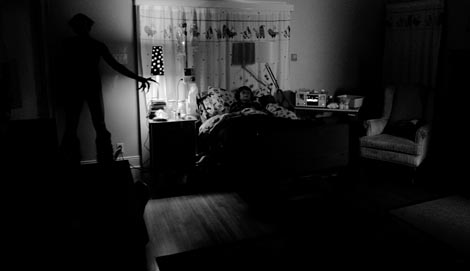
The subject matter of Insidious actually makes for an interesting story. While heavily inspired by classic Lovecraft, without giving anything away, the script delves into familiar territory but also settles on a plot element not normally used as a horror trope. This alone certainly deserves some notice but it is not enough to fulfill a vision. There are a lot of plates to balance when making a motion picture and unfortunately with Insidious the execution is lacking. The acting is unconvincing and the dialog is derivative at times. The visuals of the demons are uninspired and even downright campy. There are definitely some unintentionally laugh-out-loud moments that make this feel like a B movie.

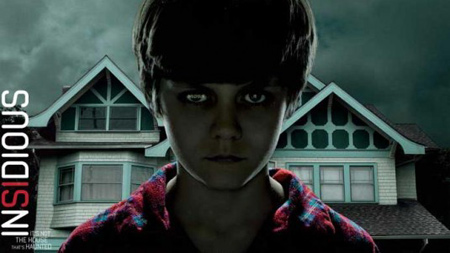
Don't trust that kid

However, and pun intended, there is something much more insidious going on that this film does a great job at- misdirection. The creators are actively aware of a moviegoer’s preconceptions and expectations and stay one step ahead. I like the twist and the meta design of the movie – using the crazy wife or the sick boy as red herrings. The makers of this film go further than merely keeping the audience guessing- they realize that their viewers have a wealth of horror movie knowledge that they will enlist to attempt to predict what happens next. There is a reason this movie borrows heavily from Poltergeist and The Exorcist. The tagline “It’s not the house that’s haunted” seems to give away the mystery while actually leading viewers to the incorrect conclusion.  The interesting twist ending is more complicated than it initially appears- the camera work subtly hints that something else is happening to keep the audience off guard. Even the box art leads the mind astray. Now *this* is managing the meta of a movie.

It’s not a great movie but remains worth watching. Some scenes can be cheesy but still scary. And the script has flaws but redeems itself in interesting ways. I can see why someone who watches a lot of movies would like this one, so in the end maybe the Blockbuster employee didn’t steer me wrong.

Lock Screen

Lock Screen

Every time I turn on my iPad, this is what I am greeted with. I understand iOS spawned from the cell phone market where a lock screen makes sense – we wouldn’t want to accidentally call contacts by mistake- but why do I need to put up with this extra step on a tablet? Slide to turn on? Didn’t I just push a button to turn this device on?

Just another reason to jailbreak, if you ask me. Apple doesn’t let you customize this lock screen away normally. Free your device!

The Trouble With Angels – Filter

Filter is one of those bands that was easy to love after their first album. I have spoken before about how they will never be the same as the good old days but when they released Anthems For The Damned a few years ago I did kind of get into it. The problem with that album is not that it’s bad but it’s generic. The choruses are powerful and I like to listen to the songs but they all bleed together. If the music was playing at someone else’s house you would bob your head to it but there was a certain lack of character that kept the album from standing out. It also featured some of the worst parts of prior albums, namely annoying screaming that didn’t contribute to the songs, a dead space track that grated the ears, and soft songs without soul meant to cater to the radio listening crowds. But overall, still, Anthems For The Damned showed a glimmer of promise.
Clouds
Clouds

Enter The Trouble With Angels, and the promise is fulfilled. All the strongest traits of Filter Nouveau are set to 11 and much of the hindrances are left behind (well, Absentee Father has a couple of eye-rolling screams). The hard songs go HARD without reprieve. Real effort has been put into giving songs individual characteristics that provide identity. The album is cohesive and flows through a few different styles without all sounding derivative of each other. The choruses are even more catchy. There is nothing ground-breaking here at all- it is just solid rock. It’s strange because the album doesn’t immediately impress itself on you but after listening to a couple tracks it is difficult not to succumb to the energy and mood of it all.

No Re-Entry
No Re-Entry

Unfortunately, much like the last album, none of the songs truly force themselves to be considered all time favorites individually. Filter is still only a fragment of the band it was since the creative duo broke apart after the first album and it’s unlikely that we’ll see their music ever top the charts again. But if you find yourself willing to accept that change happens, not always for the better, and you listen to The Trouble With Angels with open ears and an open mind, you just may find yourself subconsciously rocking out. In the end, that’s what a solid rock album is supposed to do. And that’s not such a bad thing.

Ghost Hunting Shows

What is wrong with audiences today? Why are there so many ghost hunting shows on tv now? It seems like every cable channel has one. SyFy Channel started with Ghost Hunters, A&E got Paranormal State, Discovery Channel created Ghost Lab, even the Travel Channel for some reason started Ghost Adventures.

These shows are like the specials you see on tv with some crazy person who devoted half their life looking for Bigfoot. I got news for you- if the cooky old sailor you’re watching actually found the Lochness Monster then you would have heard about it in the news WELL BEFORE the episode aired. These ghost shows are no different. But hey, if you want to hear sounds of buildings settling, someone dropping a spoon, or a scratchy static recording then by all means.


Ghost Evidence

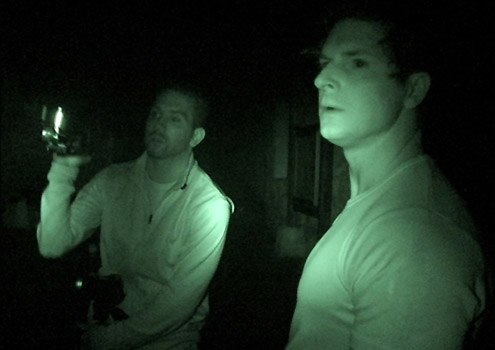
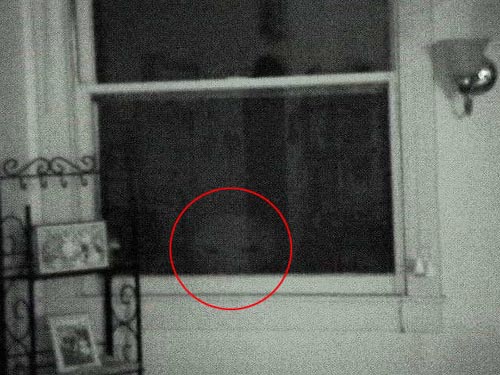
And what’s with the night vision? Can anyone tell me why the explorers refuse to turn any lights on? Even in the few cases that they are in buildings without electricity, doesn’t everybody realize that film crews don’t need to use small flashlights to capture night footage? Ok, sure, some of these teams may not have full crews, but ask yourself why not? Do the big scary cameramen spook the ghosts? Or is it likely that the producers are more interested in creating a program that looks spooky rather than has any shred of plausibility or respect for itself?


My cellphone can take better night shots than this

Even if you believed in ghosts and thought that *maybe* some of these encounters out of all these episodes were genuine brushes with reality, what you actually get to see on video is not very compelling. There is no science, there is no proof, there is nothing interesting captured on camera. Instead viewers are asked to be satisfied with the same bullshit con jobs. A bunch of “experts” are standing in a room and get startled and say, “Did you hear that?” and they all run to another room remarking about how they feel an old and evil presence close by. Then they start talking out loud- “Hello. Can you hear me?” I actually heard one guy from Ghost Adventures saying, “I call to thee!” like he was in the middle of his weekly larping game. Then the spooked hunters listen to static that they turn up really loud and make crazy claims about it, satisfied at a job well done. How is this entertainment?

DRM

What do you think about a single player game that requires you to be online every second that you play it? Pure vitriol, if internet message boards and comments are any indication. Digital Rights Management (DRM) is a wildly unpopular idea and yet another front on the war between freedom and security. In the real world at airports we fight terrorism but in the digital world piracy is the enemy. Still, the laments are the same- security measures are an inconvenience that often get in the way of the experience they exist to protect.

In the grand scheme of things media rights are a fairly trivial aspect of security and it comes easy for users to slam the need for it. I personally wouldn’t buy music with DRM and avoided iTunes because of it. Why would I buy controlled music when my entire previous collection was uncontrolled? Why would I give up that freedom?

It has taken some time but games have finally surged ahead in this realm. Valve launched Steam, a storefront to hold your game collection. It wasn’t hard to hide from people the fact that it was a DRM application but Steam offered enough perks that it actually enhanced the experience rather than destroyed it. You can buy a game and play it on PC and PS3, you can install the game on multiple machines, or delete it and always have a backup in the cloud. And you could certainly still play the games offline.

This is where the new trend of always on DRM emerges. Ubisoft has released many PC games that require an internet connection to play and there have been many complaints and calls for boycott. None of the detractors have stopped the company from claiming that their solution has successfully reduced the amount of piracy they suffered. And so, despite being popularly reviled, their business plan continues.

And this leads us to Blizzard and Diablo 3. Previous versions of the game have allowed you to have separate games for online and offline play, but no more. Diablo 3 forces a single game type, for the “convenience” of the player, that always requires an internet connection. It is obvious that this simplifies the experience for the player and the development of the game, and honestly, I will be playing this game online with friends a lot of the time. It is also clear that this is DRM to prevent piracy and will inconvenience players who can’t be constantly connected or who have a router that resets itself every night. But what I think is slipping past most people is the online auction house.

Blizzard is including a real money auction house for items in Diablo 3. Remember previous games where you had to hunt and work for items? Well this time around you can just go to the store and buy them. This is an outrage to some people as is but i’m not really opposed to the concept of microtransactions on face value. However, I’m of the mind that the reason Blizzard always wants you to be online is so you can partake in the auction house. You can’t buy gear if you aren’t online after all. And think about the item economy. If you could play offline and save locally, you could hack the save files and get free items. This obviously doesn’t work when you can easily sell these items for real money, endorsed by Blizzard. Of course there would still be the limitation of not allowing SP and MP items to mix, but what happens when you buy an item in SP – should that extend to MP as well? Shouldn’t it because you paid for it?

These are all problems that have solutions, but Blizzard is solving an awful lot of their problems by forcing you to be online all the time, and they are leaning heavily on their online World of Warcraft expertise. This is a case where I actually think piracy isn’t the driving concern of requiring an internet connection. Don’t be fooled by Blizzard’s claims that they are not planning on making money off the auction house and just expect it to cover server costs. That’s laughable. And dishonest.

So when it comes down to it, is Blizzard doing anything wrong? They are following the rule of popular DRM in that it will offer the users more features than if it didn’t exist. They are vastly simplifying item management and relying on existing technology by using their Wold of Warcraft (always on) knowledge. As a developer myself I need to respect those points. I’m sad to say it but I don’t think this move bothers me a whole lot and I only see the industry moving towards this model more in the future. Soon we will see ads, like on web pages, in digital storefronts like Blizzard’s auction house. Games are becoming more connected to the web and social media and marketplaces that soon enough the line will be so blurred that we will forget what we were complaining about here. The golden rule will, as always, be to make sure the game itself does not suffer.

A Dance With Dragons

George R. R. Martin’s A Song Of Ice And Fire series is not just a new phenomenon- all 4 previous entries have been New York Times bestsellers with the last hitting number one. The draw of the novels are without a doubt the many complex characters involved, the well imagined and far ranging world, and of course the intricate plotlines. Countless houses and families interweave across lands familiar and new, all inevitably tying together through the plots of kings and men.

That said, the lands of Westeros and beyond are a hot topic these days for a couple reasons. First, HBO created and aired a hit season based on the first book of the series, with more to come. And second, because the fifth book out of seven, A Dance With Dragons, was finally released after a wait of more than 5 years. Since I haven’t mentioned A Song Of Ice And Fire on Why I Hate Everything before, I will recap a bit before getting to the new book.

A Game Of Thrones was a great first novel that introduced a world and had specific plot arcs in mind. Westeros is a medieval land without all the fluffy magic that we are used to in the fantasy genre. Politics and bloodlines are the star of the show here. Since the tv season portraying this book finished airing and the novel has a bigger following now I may touch on a couple generic spoilers without getting to the big ones. A Game Of Thrones is about an honorable family in the north that gets embroiled in politics that ultimately threatens to be the ruin of them all. The novel tracks all the members of the family being split up to their own separate dangers and adventures. Some plotlines were tied up but most were left open ended with many a possibility and question unanswered.

Rightly so, the next couple of novels in the series had a lot of source material to lean on. Various characters across numerous lands provided many rich backdrops to explore. New characters who were previously footnotes became the focus of new plights as well. A Clash Of Kings and A Storm Of Swords relied on the first book to set the sequence of events and these books were somewhat a matter of simply letting the dominoes fall. But after (and maybe by the end of) these two entries some of the luster was lost. It became hard to ignore a pattern of random dangers presenting themselves and oft times leading to the worst possible outcomes. Martin is not known to be kind to his characters but this only stays refreshing as long as it does not become predictable. More troubling is that now a few books into the series, with some large notable exceptions, many characters were still more or less in the same place as where the first book left off.

Then we get to the fourth book, A Feast For Crows. This novel is the culmination of a wandering story, taking too long for anything to happen while focusing on characters that are difficult to care much for. A Feast For Crows was the worst book in the series by far. It was long and meandering for what little point it had. I’m not saying that there wasn’t good color to the tales told within but as a portion of the greater story it served little good. This book had so much fluff in it that it became too long. Aside from taking 5 years to be released it cut half the characters and story out- to be split into the next book. Essentially, A Feast For Crows and A Dance With Dragons cover the same time period but just focus on different characters. Martin assures us that the reason for this division was to tell the full stories of half the characters rather than half of the story of all the characters. Except near the end of A Dance With Dragons we start seeing characters from A Feast For Crows reappear as the timeline becomes recombined. So much for the characters having their full stories told in each book, huh?

Anyway, the deficiencies of the fourth entry became the strengths of the fifth. It was good to once again read about characters that were missed in the context of what had already happened. And when the timelines combine it was nice to finally know that all was right with the chronology once again. However, there was a notable change in A Dance With Dragons. Reading the previous book impressed upon me a sense that it was long, meandering, and unplanned. A Dance With Dragons, on the other hand, rushed forward to introduce some important new characters and undo some of the situations set up earlier.

It is said that Martin took some time between books to plan out the rest of the series and get a sense of how book 7 should end and work backwards. It is clear to me that there was a definite plan and need to get the cogs in motion in order to get A Song Of Ice And Fire back on track again. While there are still some chapters in the latest book that are nothing but fluff, it feels good to know that the momentum once again has direction.

A Dance With Dragons is not a perfect book by any means. It still mostly misses out on half of the characters, abandons others in awkward spots only halfway through the reading, and speeds certain events along to get them set up for what’s coming next. Still, a living, breathing world with a lot of colorful nations and traditions is discovered within. And most importantly, I believe it is serving the purpose of getting the A Song Of Ice And Fire train back on the tracks. Books 6 and 7, I expect, will be much more tight and satisfying when all is said and done.